
BYZANTİON TRAVEL
Ancient Town Istanbul
DESTINATIONS


ISTANBUL
The wonders of Istanbul! A city that takes your breath away. A unique blend of ancient and modern. A heritage that goes back thousands of years – architecture, religions, cultures and peoples all mixed to become what is today one of the most vibrant and exciting cities of the world!


CAPPODOCIA
Cappadocia (known as Kapadokya in Turkey) is located in Eastern Anatolıa The name was used traditionally by Christian sources throughout history and is still used internationally to described this unique area of natural landscape characterized by what have become known as Fairy Chimneys!
In ancient times it stretched from The Taurus Mountains in the south, to the vicinity of the Black Sea to the north, the Euphrates to the east and Lycia to the east. It is believed the name was first applied to the area by the Persians.
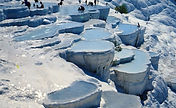
PAMUKKALE
Pamukkale is located north of Denizli in Western Turkey. The word meaning Cotton (Pamuk) Castle (Kale) in Turkish describes it’s amazingly white travertine formations. It has been on the UNESCO World Heritage List since 1988.
Famous for it’s hot springs and stream deposited carbonate minerals, Pamukkale is believed to have curative minerals. People have bathed in it’s thermal waters for thousands of years and legend has it that Cleopatra once bathed here.

NEMRUT Mountain of the Gods
Mt Nemrut is located between the two cities of Malatya and Adiyaman in Eastern Anatolia and is one of the most amazing sights in Turkey. A tumulus on top of the mountain faces both the western and eastern side with huge limestone statues of Apollo Fortuna and Zeus Heractes. There are also two lions, two eagles and bas-relief figures that appear to be part of a large frieze of various gods. At some time in history the heads have been removed from the bodies and are scattered on the mountain. The statues have not been restored to their original positions and lay where they have fallen. The Commagene was one of the Selecid successor states and occupied land between the Tauras Mountains the Euphratres. No one knows what lies beneath the actual tomb of Antiochos and there is no entrance visible. Mt Nemrut was declared a World Heritage Site in 1987. It is included in our Eastern Turkey tour and can be also visited from Cappadocia. During the months from November-April Mt Nemrut is covered in snow.

Antalya
Anataya is a city on the Mediterranean Coast in South West Turkey It is the largest sea resort located on the Turkish Riviera It is the third most visited city in the world behind Paris and London with over 10 million visitors each year. The name originated from Greece Attaleia and was named after its founder Attolos 11 King of Pergamom. The date of founding is uncertain but believed to be 150BC when it was a naval base for Attalias powerful fleet Later explorations put it at 300BC Antalya became part of the Roman Empire in 133 BC when King Attalos 111 bequeathed it to Rome after his death It prospered during the ancient Roman period.
BURSA/The Green City
Bursa was the first capital of the Ottoman Empire during the time 1335 to 1413. The city dates back to the 4000BC and was at the heart of the old silk road. Today it is the 4th largest city in Turkey and well known for its textiles and of course as Turkeys centre for silk production.
GALLIPOLI
The Gallipoli Peninsula is located on the western side of Turkey known as Thrace. It has an ancient Greek and Roman history. However since WWI and the landing of the Anzac Troops on 25 April 1915, it has become a pilgrimage place for Turkish, Australian and New Zealand people, many of whom have relatives who fought and died there.
FETHİYE
In ancient times, Fethiye was known as Telmossos. Legend has it that in Lycian times the young god Apollo fell in love with the youngest daughter of King Phonecia and turned himself into a small dog to win the love of this shy girl. Afterwards he turned himself back into a handsome young man and together they had a son named Telmossos.

TROY
The ancient city of Troy was founded in about 3000 BC. From 3000 BC to 1700 BC, Cities Troy 1-Troy V had a similar culture. From 1700 BC Troy changed with increasing sophistication in house building and pottery, and increasing trade with Greece.
It is believed under King Priam in Troy V1 that the Trojan Wars took place. An earthquake in 1250 BC damaged the walls and hastened the Archaean victories. Troy V11 lasted from 1250BC to 1000BC. After an invasion around in 1200 BC by the Balkan people, Troy declined for 4 centuries until it was rebuilt as a Greek City (Troy V111 700-85 BC).